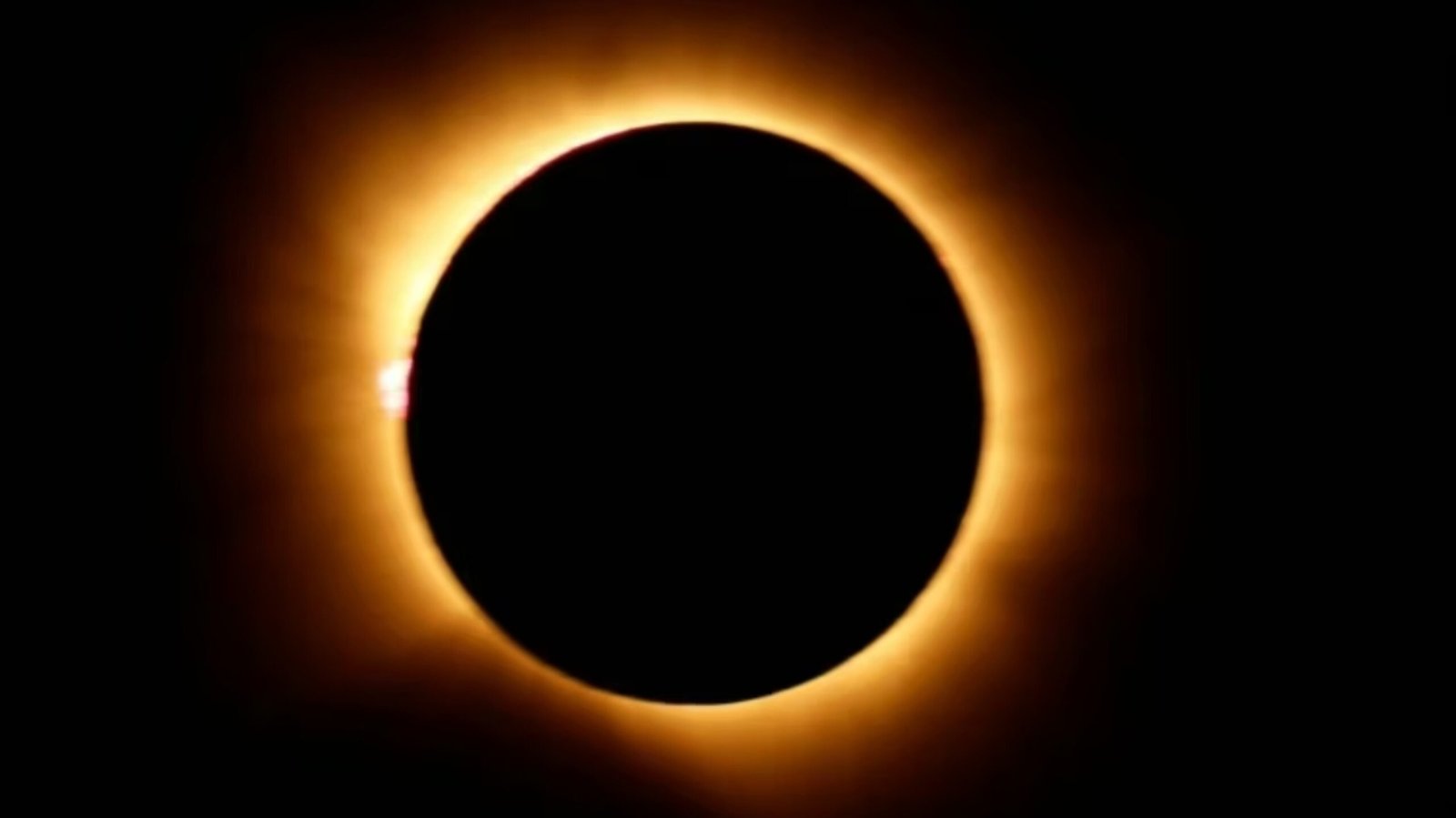
Millions of people across Europe looked towards the sky on Wednesday as a total solar eclipse moved across parts of the continent, creating a rare and spectacular view. The Moon passed directly between the Earth and the Sun, temporarily blocking sunlight and turning areas along the eclipse path unusually dark.
The path of totality was less than 300 kilometres (186 miles) wide and stretched from the northwest towards the southeast, covering Iceland, Britain and parts of mainland Europe before reaching the Balearic Islands, including Mallorca. A small area of Portugal also experienced the Moon’s full shadow, while a partial eclipse was visible across much wider areas of Europe.
At the Ebro Observatory in northeastern Spain, hundreds of spectators watched in silence as the Moon completely covered the Sun. The event created a striking black disc surrounded by a bright ring of sunlight, known as the solar corona. Crowds across different locations reacted with applause, cheers, tears and moments of silence as totality began.
The eclipse started over northern Siberia before the Moon’s shadow travelled across Greenland and Iceland. It later reached Spain at around 8:30pm local time, or 18:30 GMT. Spain provided some of the clearest viewing conditions, although temperatures in parts of the country were close to 40 degrees Celsius (104 degrees Fahrenheit).
In Reykjavik, Iceland, however, clouds and rain made it difficult for many people to see the total eclipse clearly. Weather conditions played an important role in determining how much of the event spectators could observe.
A total solar eclipse occurs when the Sun, Moon and Earth align closely, allowing the Moon to cast its darkest shadow, known as the umbra, onto the Earth. Areas inside the umbra experience totality, while locations within the wider penumbra see only a partial eclipse.
During totality, daylight can briefly turn into near darkness. Temperatures may fall, and some stars and planets can become visible as the Moon blocks the Sun. The rare alignment makes total solar eclipses one of the most impressive natural events visible from Earth.